
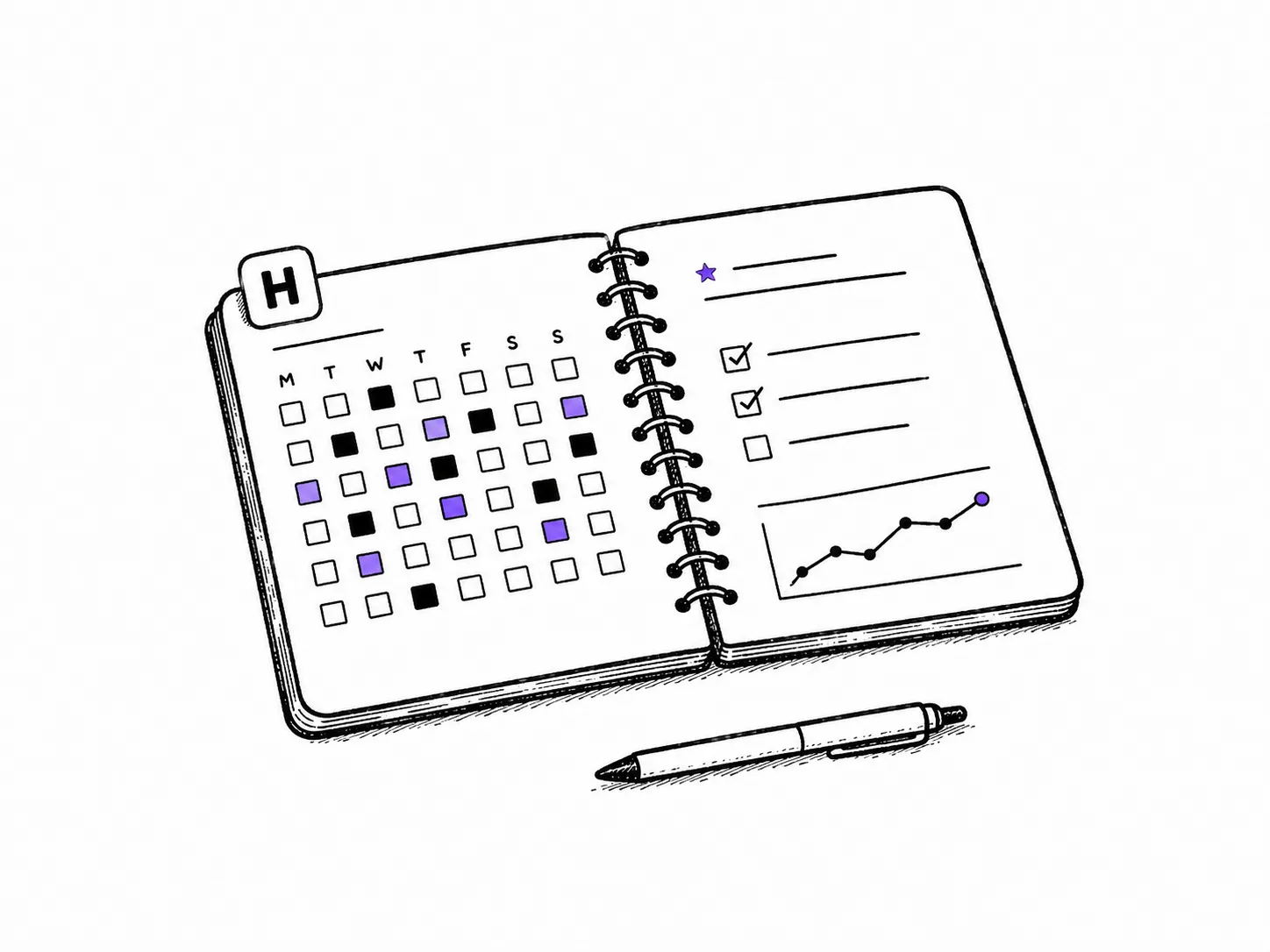
HabitHeat is a minimal habit tracker that turns small daily entries into a long-term visual history.
That is probably the simplest way I can describe it.
You create habits, log small entries, and over time those entries turn into heatmaps, statistics, patterns, and a record of what you kept coming back to. At first, the app can feel very simple. You add a habit, check something off, enter a number, start a timer, or write a short note.
One entry does not feel like much.
But most habits are like that.
A short meditation session, a few pages read, a workout, a walk, a study session, a day without a bad habit, or a small journal note can all feel almost too small to matter in the moment. The value is not always visible on the day itself. It becomes visible later,
That is what HabitHeat is built around.
Not just tracking whether you did something today, but giving you a simple way to see how your habits changed over weeks, months, and years.
A habit tracker built around heatmaps
The heatmap is the center of HabitHeat.
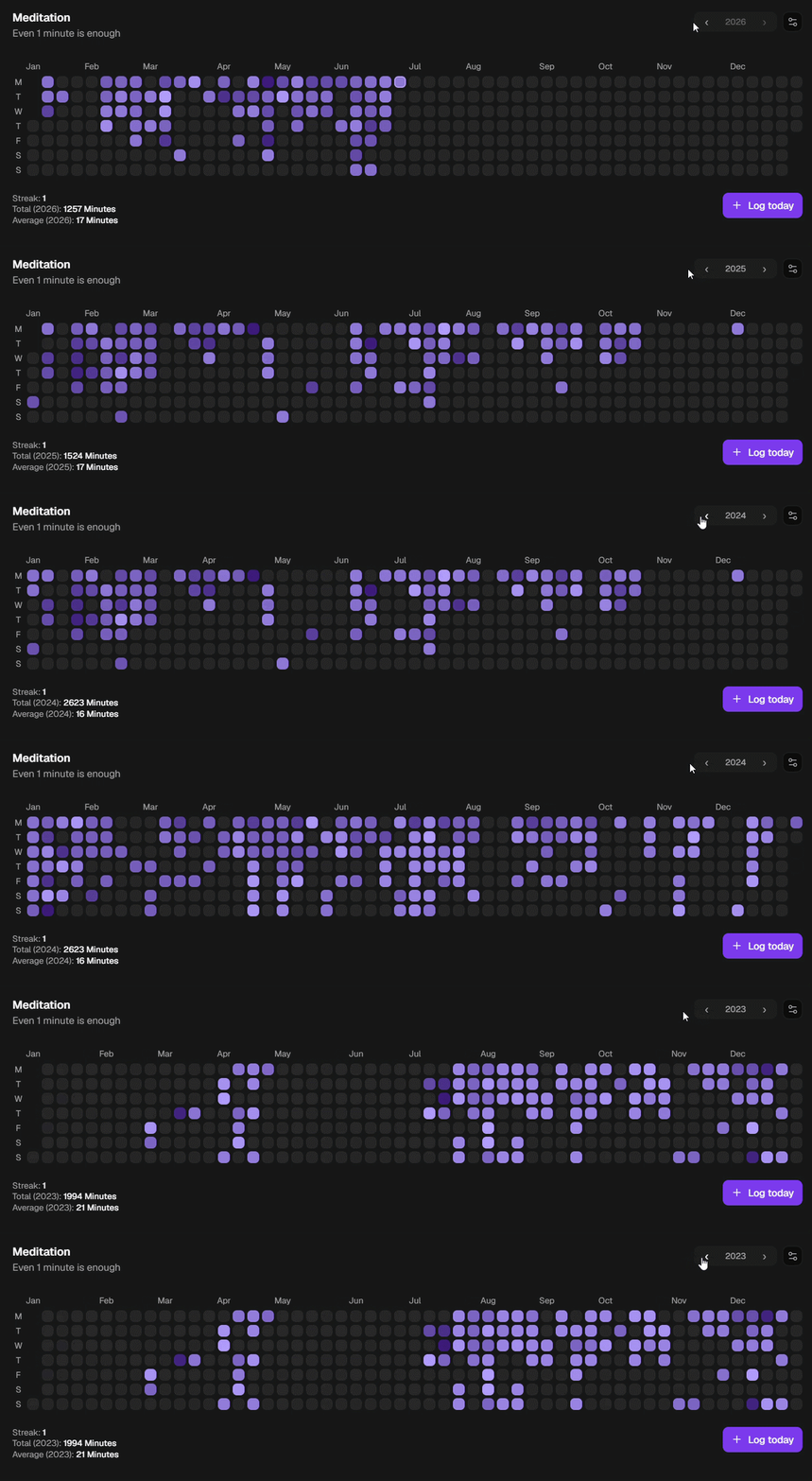
Each cell represents a day. Empty days stay quiet. Logged days become visible. Over time, the grid starts to show consistency, gaps, strong phases, slow months, and the habits you returned to after disappearing for a while.
I like heatmaps because they show time honestly.
A checklist mostly cares about the current day. Did you do the habit or not? That can be useful, but it is only one small part of the story. HabitHeat cares about today too, but the app becomes more useful when you zoom out.
After a week, the habit has a small shape.
After a month, the first patterns appear.
After a year, the heatmap becomes something you could never remember clearly from memory alone.
That visual history is what made me interested in habit tracking in the first place. Before HabitHeat existed, I used notebooks, handwritten grids, Google Sheets, checkmarks, minutes, and small notes. A lot of it was messy and manual, but I already liked the feeling of seeing a week or month slowly fill up.
A single checkmark did not mean much.
A full page of checkmarks did.
HabitHeat is the digital version of that feeling. Small daily entries are collected, organized, and shown in a way that makes the long-term picture easier to understand.
Different habits need different kinds of tracking
Not every habit works the same way.
Some habits are simple. You either did them or you did not. A workout, a reading session, taking vitamins, avoiding a bad habit, or doing a small daily routine can work perfectly well as a simple checkbox.
Other habits need more detail.
Meditation is a good example for me. I do not only care whether I meditated. I also care how many minutes I meditated. A 3-minute session and a 30-minute session can both be valid, but they are not the same. If both are tracked only as “done”, useful information disappears.
The same is true for pages read, push-ups, walking distance, study time, focus sessions, writing, or anything else where the amount matters.
That is why HabitHeat supports different habit types.
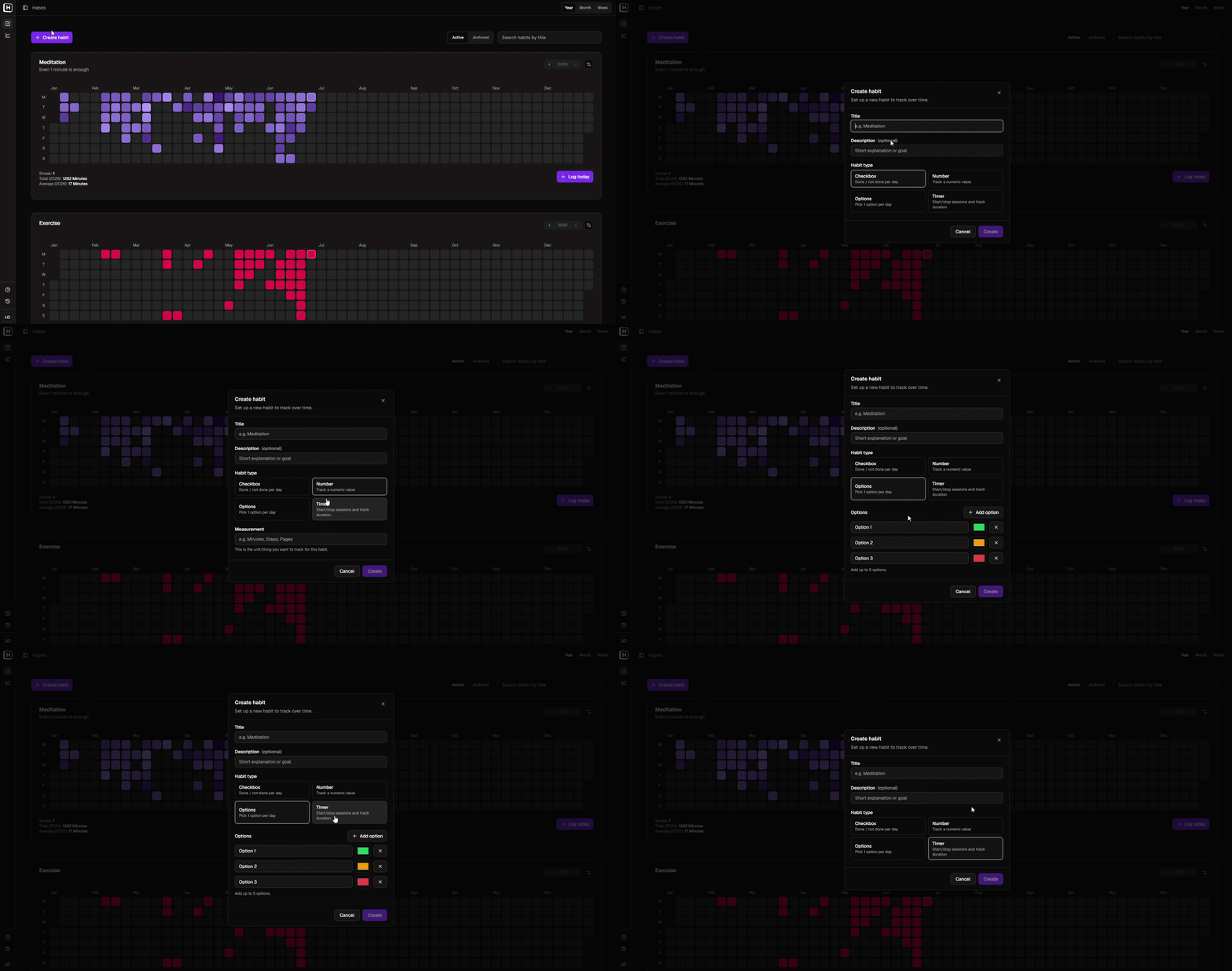
You can track simple done-or-not-done habits, number-based habits, timer habits, and habits where options or values make more sense. The goal is not to make habit tracking complicated. The goal is to avoid forcing every habit into the same format.
Real habits are different from each other.
Some are about showing up. Others are about volume, time, intensity, mood, context, or reduction. A good habit tracker should be flexible enough for that, while still feeling easy to use.
That balance is important to me.
HabitHeat should support different ways of tracking without becoming heavy. Creating a habit should still be simple. Logging an entry should still be quick. The interface should stay minimal, even if the system behind it can handle more than one kind of habit.
Small daily entries can mean different things
A small daily entry in HabitHeat does not always look the same.
For one habit, it might be a checkmark. For another, it might be 17 minutes of meditation, 25 pages read, a timer session, a selected option, or a short note about the day.
Even an empty day can become part of the history.
That is something I care about. Habit tracking should not only be about collecting perfect days. Gaps matter too. Quiet months matter. Coming back after a break matters. A habit that disappears for three weeks and then returns is still part of your life in a different way than a habit you never touch again.
HabitHeat tries to show that without making it dramatic.
You log what happened, and the heatmap changes.
That is enough.
The app does not need to turn every entry into a big event. It does not need to make missing a day feel like a failure. It just keeps the history and lets the pattern become visible over time.
Analytics explain what the heatmap shows
A heatmap is great for seeing the shape of a habit, but sometimes the shape needs more context.
That is where analytics come in.
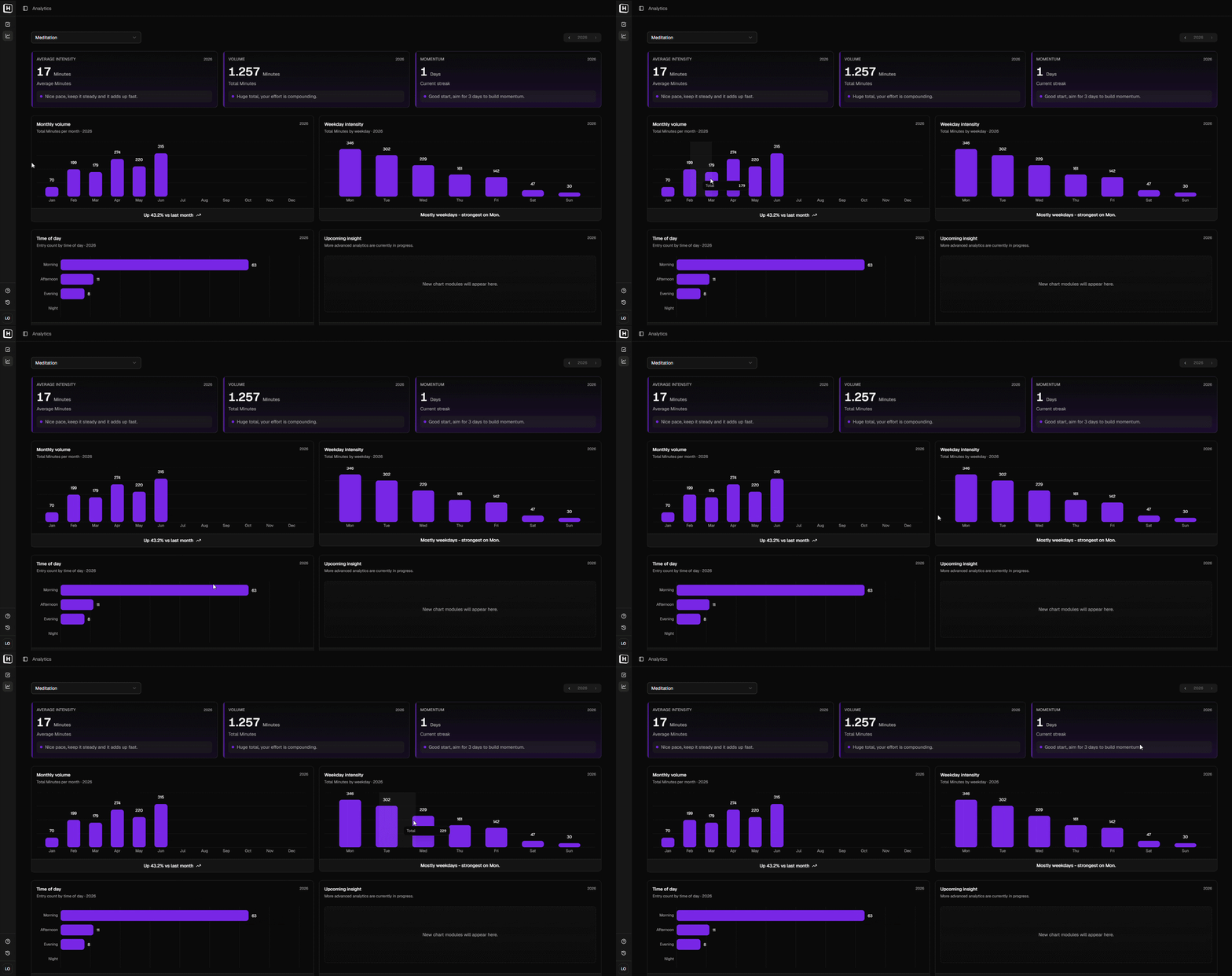
HabitHeat includes statistics because I do not only want to see that I tracked something. I want to understand what changed. How many minutes did I meditate this year? Which month was strongest? Which weekdays worked best? Did my average session length change? Did I do more this year than last year? Was I consistent, or did I mostly show up in short phases?
These are the kinds of questions that make habit data interesting to me.
My own meditation habit is still the best example. A single meditation session can feel small. Ten minutes can feel like almost nothing. But when I look at a full year, I can see the total volume, the strongest months, the long gaps, and the times when I came back.
That changes the feeling of the habit.
It is no longer only about whether I meditated today. It becomes a record of how meditation appeared in my life over time.
The analytics in HabitHeat are not meant to turn your life into a business dashboard. I do not want to add charts just because charts are possible. The goal is to show useful context around your habits while keeping everything understandable.
A heatmap shows what happened.
Analytics help explain how it changed.
Journal entries add context
Numbers are useful, but they do not explain everything.
A gap in a habit often has a reason. Maybe work was stressful. Maybe you were sick. Maybe you moved, changed jobs, traveled, lost interest, or focused on something else for a while. The heatmap can show the gap, but it cannot always explain it.
That is why HabitHeat also includes journal entries.
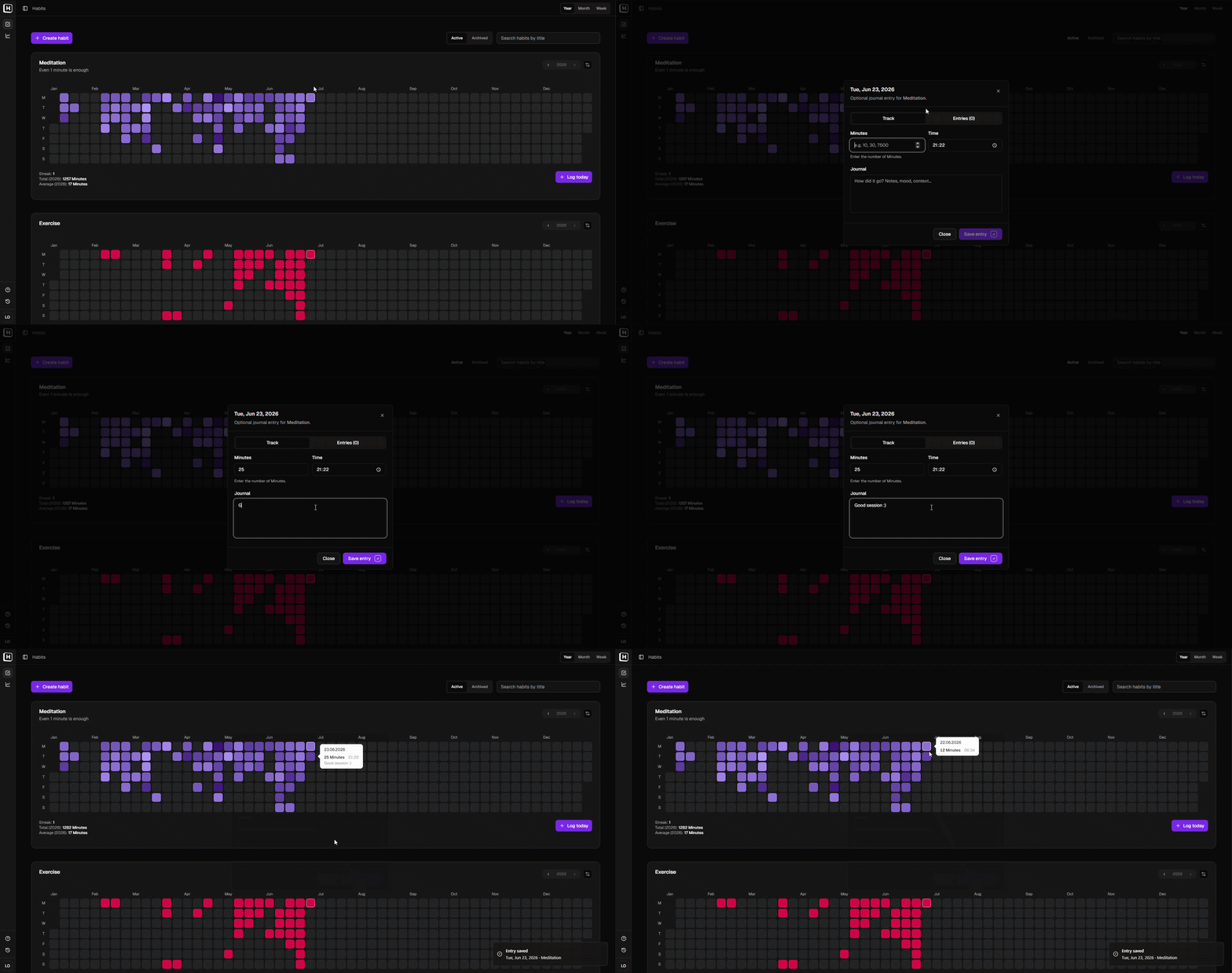
A habit entry can have a note attached to it. It does not need to be long. One sentence can be enough to preserve the context around a day, a session, or a phase.
The goal is not to turn HabitHeat into a full journaling app. The goal is to let your habit history keep some of the meaning that numbers alone would lose.
I like that because old habit data often connects directly to memory.
When I look at my own heatmaps, I can usually remember what certain phases felt like. A stressful month, a strong routine, a job change, a good period, a quiet period. If I added a note at the time, the memory becomes clearer.
That is where HabitHeat starts to feel less like a tracker and more like an archive.
Not a perfect archive. Not a complete diary. Just a small place where behavior and context can live together.
Minimal on purpose
HabitHeat is intentionally minimal.
That does not mean it should feel empty or unfinished. It means I do not want the app to be louder than the habits themselves.
Many productivity tools are built around pressure. More reminders, more badges, more urgency, more notifications, more reasons to come back every day. I understand why that exists. It can work, and some people like that kind of product.
HabitHeat is supposed to feel different.
I want it to feel like a quiet place to check in with yourself. You open the app, log what happened, look at the heatmap, maybe check your analytics, maybe add a note, and then leave.
No pressure.
That line is important to me. The core experience should not punish you for being inconsistent. Real habits are messy. People miss days. Routines break. Life changes. Some habits stay, some disappear, and some come back later.
The app should be able to hold that without making it feel like failure.
This is also why the design moved in a calmer and more minimal direction over time. HabitHeat is built around clear surfaces, simple controls, heatmaps, useful statistics, and a focused interface. It should feel easy to return to, even if you have not used it for a while.
That matters because habits often work the same way.
Returning is part of the process.
HabitHeat is not a to-do app
HabitHeat is not really a to-do app.
A to-do app is mostly about tasks. Something needs to be done, and after it is done, it can disappear. That works well for many things, but habits are different.
A habit is not finished in the same way.
You do not meditate once and then remove meditation from your life. You do not read on one day and call reading complete forever. You do not work out once and close the task.
Habits repeat, but not always perfectly. They can be daily, weekly, occasional, seasonal, or tied to certain phases of life. Some habits become part of your identity. Others only matter for a short period. Both can be worth tracking.
That is why a habit tracker should feel different from a task manager.
HabitHeat is not focused on clearing a list.
It is focused on building a record.
The entry today matters because it becomes part of something larger. Over time, your habit history becomes a way to understand how you actually lived certain parts of your life. What you practiced. What you ignored. What you returned to. What slowly became normal.
That makes HabitHeat less about productivity in the narrow sense and more about awareness.
The app becomes more useful over time
On the first day, HabitHeat is simple.
You create a habit, log an entry, and see a cell appear.
That is useful, but it is not the real value yet.
The real value appears later. After a few weeks, you can see early patterns. After a few months, you can tell whether a habit is actually becoming part of your life. After a year, you can look back at something that would be hard to remember clearly without tracking.
That is one of my favorite things about HabitHeat.
It gets better with time.
The app does not need to feel exciting every day. It only needs to make logging easy enough that the history can grow. The reward is not always immediate. Sometimes the reward comes months later, when you open a habit and see what all those small entries became.
That is why “visual history” feels like the right phrase for HabitHeat.
It describes HabitHeat better than pure motivation or productivity.
HabitHeat is not trying to make every day feel huge. It is trying to make the long-term shape of your habits visible.
Why I keep building HabitHeat
I keep building HabitHeat because I still use it myself.
My own meditation habit is still in the app. It has years of data now. Some years are stronger than others. Some months have big gaps. Some sessions are short, others are longer. The data is not perfect, but it is real.
When I look at that heatmap, I do not only see numbers.
I see phases of my life.
That is what makes it meaningful to me. HabitHeat started because I wanted to understand my own habits better. Over time, other people started using it too. Now thousands of habit entries have been logged in the app, which still feels strange in a good way.
Something that started as a personal tool slowly became something other people use to build their own histories.
That makes me want to keep improving it.
Not by adding every feature I can think of, but by making the core experience better: logging, heatmaps, analytics, journal entries, customization, export, mobile use, and the overall feeling of returning to the app.
I want HabitHeat to stay focused: flexible enough for real habit tracking, useful without becoming loud, minimal without feeling empty, and personal without locking your data away.
That is the direction I want to keep moving in.
So what is HabitHeat?
HabitHeat is a minimal habit tracker that turns small daily entries into a long-term visual history.
You can use it to track habits, routines, goals, experiments, or things you want to understand better over time. It supports simple checkmarks, numbers, timer sessions, options, and notes. It shows your habits as heatmaps, adds context with analytics, and lets your history become clearer the longer you use it.
Underneath all of that, the idea is simple.
Small things add up.
A single entry is easy to forget. A year of entries is not.
HabitHeat exists to make that visible.
Thanks for reading,
Philip