

On a good day, it is easy to work out, read, meditate, clean, study or work on your project. You have energy, your mood is good and the habit feels like something you actually want to do. These days are nice, but they are not really the problem. The real problem starts on the days where you are tired, stressed, annoyed, busy or just not in the mood at all.
I think this is where most habits break. Not because people are lazy, but because the habit they built only works when life is easy. The plan sounds good in theory. Work out every day. Read 30 minutes every evening. Meditate every morning. Write every night. But then real life happens and suddenly the standard feels too high. You miss once, then again, and after a few days the habit is gone.
That is why I like the 1% rule. It is not a magic productivity hack and it will not instantly change your life. But it gives you something very useful: a fallback for bad days.
What is the 1% rule?
The 1% rule is simple. On days where you dont feel like doing the full habit, you only do the smallest possible version that still counts as showing up.
Not the perfect version. Not the version you planned when you were motivated. Not the version you would do on your best day. Just the smallest version of the habit that keeps it alive.
If your habit is working out, 1% could be a few pushups or two minutes of stretching. If your habit is reading, 1% could be one page. If your habit is writing, 1% could be one sentence. If your habit is cleaning, 1% could be putting away a few things from your desk. If your habit is working on a project, 1% could be opening the project and fixing one tiny thing.
This sounds almost too small, but that is exactly the point. A full workout can feel like too much. One pushup does not. Reading for 30 minutes can feel annoying when you are tired. One page is still possible. Working on a big project can feel overwhelming. Opening it and doing one small task is easier.
The goal is not to make every day intense. The goal is to make the habit easy enough that you do not fully disconnect from it.
Why starting is usually the real problem
A lot of the time, the habit itself is not the hardest part. Starting is.
I notice this most with working out. Sometimes I dont actually hate the workout. I just dont want to start. Changing clothes, getting ready, doing the first set and mentally committing to the whole session feels annoying. The moment before starting is where my brain comes up with all the excuses.
“I can do it tomorrow.”
“It is already too late.”
“I dont have enough energy today.”
“I should probably do a proper session instead of a bad one.”
And sometimes those excuses even sound reasonable. But the problem is that skipping completely makes it easier to skip again. One missed day is not a big deal, but the pattern that can follow is the real danger.
The 1% rule helps because it lowers the mental barrier. Instead of asking myself to do a full workout, I only ask myself to do a few pushups. That is small enough that there is not much to argue about. And most of the time, once I start, I end up doing more anyway.
Not always. Sometimes it really stays at a few pushups. But even then, it is still better than nothing. I showed up, even if it was only for a small version of the habit.
Bad days need a smaller version
I think one mistake with habits is that we plan them for the best version of ourselves.
The version that sleeps well, has a clean schedule, feels motivated and has enough time for everything. But that version is not always there. Real life is messy. Some days are good, some days are okay and some days are just bad. If your habit only works on good days, it is probably too fragile.
That is why every habit needs a smaller version. A version you can still do when things are not ideal.
This does not mean you should always do the minimum. On good days, you can still do the full habit. You can train properly, read more, write more, learn more or work longer. The 1% rule is not there to make you lazy. It is there to protect the habit when the full version is not realistic.
For me, this is the difference between quitting and staying connected. If I miss a workout completely, the habit gets weaker. If I do a tiny version, it stays alive. It might not be impressive, but it keeps the door open for tomorrow.
And that matters more than it seems.
The problem with all or nothing thinking
A lot of habits die because they are built around all or nothing thinking.
Either I do the full workout or it does not count. Either I read 30 minutes or it does not count. Either I meditate properly or it does not count. Either I work on the project for two hours or it was not productive.
This makes habits way too easy to break. If the only thing that counts is the full version, then every imperfect day becomes a failure. And once you feel like you failed, it becomes much easier to stop completely.
The 1% rule removes some of that pressure. It gives you a middle option between perfect and nothing.
You dont have to decide between doing everything and doing nothing. You can do the small version. You can keep the habit alive without pretending that every day is going to be perfect.
I dont think consistency means doing the exact same amount every single day. That sounds nice, but it is not how life works. For me, consistency is more about returning. Some days you do a lot. Some days you do the minimum. Some days you miss. The important part is that you dont drift away completely.
How to use the 1% rule for your habits
The best time to define your 1% version is before you need it.
When you are already tired or unmotivated, you probably will not make the best decision. You will negotiate with yourself, lower the priority and maybe skip the habit completely. So it helps to decide in advance what the smallest version of each habit is.
For a workout habit, your 1% version could be five pushups, one set or two minutes of stretching. For reading, it could be one page. For writing, it could be one sentence or one rough note. For meditation, it could be sitting down and taking one deep breath. For cleaning, it could be clearing one small surface. For coding, it could be opening the project and fixing one tiny issue.
The important part is that it has to be actually small. A “short 30 minute workout” is not really 1%. That is just a normal workout with a different name. The tiny version should feel so easy that skipping it feels almost harder than doing it.
After you finish the tiny version, you can always continue. But you do not have to. That is the whole point. The small version counts by itself.
And funny enough, this often leads to doing more. Once you are already moving, the task usually feels less difficult than it did before starting.
Why this matters for habit tracking
This is also why I think habit tracking should not only be about perfect streaks.
Streaks can be motivating, but they can also make habits feel fragile. If the whole system depends on never missing, one bad day can feel like the entire habit is broken. But real habit progress is not always a perfect chain. It is usually uneven. You have strong phases, weaker phases, small wins, missed days and moments where you come back.
A good habit tracker should help you see that bigger picture. Not just “did I win or lose today?”, but “am I still moving in the right direction?”
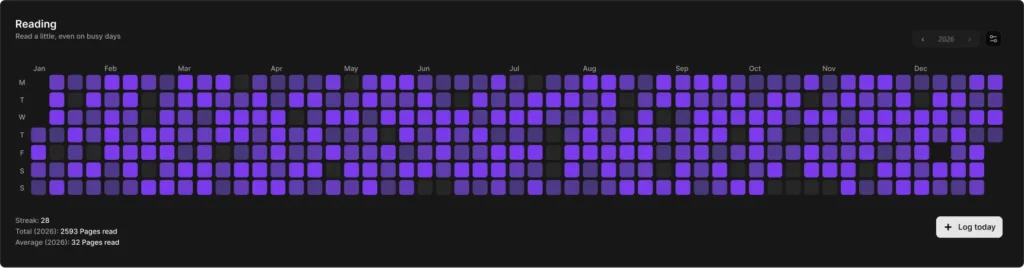
That is one reason I like visual habit tracking. When you look at your habits over weeks or months, you can see patterns more clearly. You can see where you stayed consistent, where you slipped and where you came back. A single weak day does not define the whole habit anymore. It becomes part of the pattern.
Those small 1% days might not look impressive in the moment, but they are often the reason a habit continues. They stop a bad day from turning into a full reset. They give you something to build on tomorrow.
And when you track your habits in HabitHeat, those small actions become visible. You are not only tracking perfect days. You are tracking continuity. You can see that even low-effort days still count as part of your progress.
The 1% rule is part of a bigger system
The 1% rule works best when it is part of a bigger habit system.
On its own, it helps you get through bad days. But it becomes even stronger when you combine it with other simple rules, like making habits easier to start, not missing twice in a row and using tracking as feedback instead of pressure.
That is how I think about habits in general. Motivation is nice, but you cannot rely on it every day. A better approach is to build a system that assumes bad days will happen and gives you a way to recover instead of quitting.
The 1% rule is one part of that system. It protects the habit when motivation is low. It gives you a minimum standard. It makes starting easier. And most importantly, it helps you keep going without needing every day to be perfect.
Final thoughts
The 1% rule is simple, but that is why I like it.
On good days, you probably do not need it. You just do the habit normally. But on bad days, it gives you a way to stay connected to the habit without forcing yourself into the full version.
Instead of asking “can I do this perfectly today?”, ask “what is the smallest version I can still do?”
Most of the time, that small start will turn into more. And if it does not, that is fine too. You still showed up. You kept the habit alive. You made it easier to continue tomorrow.
Building habits is not about being perfect every day. It is about staying consistent long enough that the habit becomes part of your life.
1% is still progress.