
Before HabitHeat was an app, it was just a way for me to understand my own habits.
It started with notebooks, Google Sheets, and a simple interest in how small actions add up over time. Around 2019 or 2020, I became really interested in habits, behavior, psychology, and the idea that the things you do regularly slowly compound, even when you do not notice it day by day.
I read books like The Power of Habit, The 7 Habits of Highly Effective People, Atomic Habits, Tiny Habits, and a lot of other psychology-related books. Some of them were practical, some were more philosophical.
The exact sources changed over time, but the idea that stayed with me was simple: habits compound.
If you keep doing good things regularly, your life can slowly get better. If you keep doing destructive things regularly, your life can slowly get worse. It is not always visible in the moment, but over time it adds up. Knowledge compounds. Health compounds. Money compounds. Behavior compounds.
That idea always fascinated me.
It is also one of the reasons I recently started investing more seriously. Investing money and investing in yourself feel very similar to me. If I meditate regularly, the benefits compound. If I keep learning, my skills compound. If I work out, invest, read, build projects, or improve the way I think, those things may not feel huge on a single day, but they can slowly change the direction of my life.
HabitHeat grew out of that idea.
I wanted a way to look at those investments in myself.
Before HabitHeat, there were notebooks and spreadsheets
The first versions of my habit tracking were very simple. I used notebooks, handwritten tables, checkmarks, and weekly habit grids. I would draw a table with the days of the week from Monday to Sunday, put the habits on the left side, and then check off the days where I did them. It was basically a small paper heatmap before I had ever built a real one.
At the beginning, I mostly tracked things like learning and meditation. For learning, I tracked how much time I spent and sometimes what I worked on. For meditation, I tracked the minutes or just whether I did it. Sometimes I also wrote small journal notes next to the entries. It was not a polished system, but I already liked the feeling of seeing a week or a month fill up.
A single checkmark did not mean much. But a full page of checkmarks did.
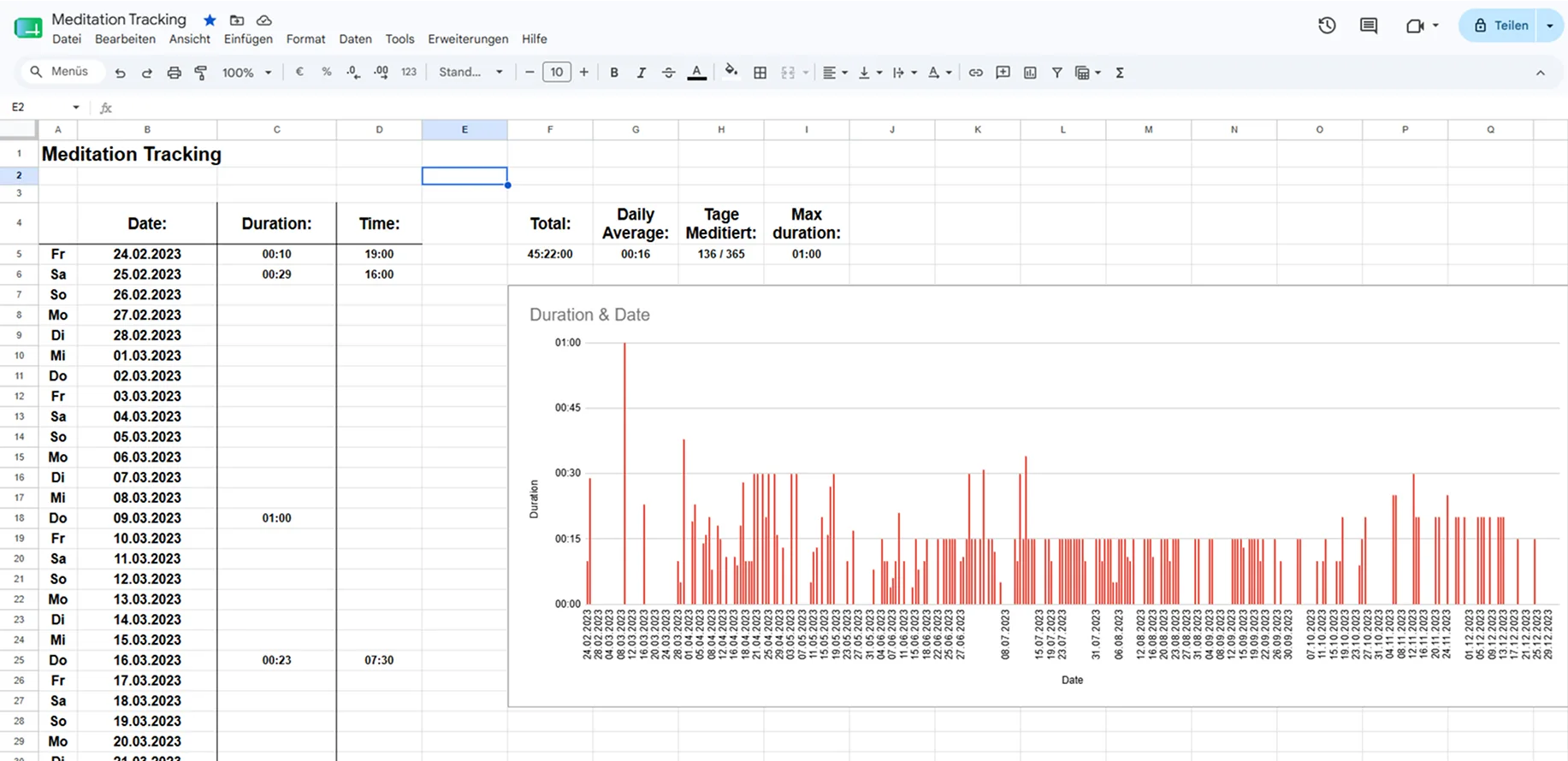
Later I moved more of this into Google Sheets. That made it more flexible. I could track minutes, calculate totals, use formulas, compare things, and build some very basic analytics. It was still rough, but it already had a lot of the thinking that later became HabitHeat: I did not just want to mark a day as done. I wanted to understand what happened over time.
I still have some of those old spreadsheets. Looking back at them is kind of funny, because they are messy and very manual, but the core idea is already there. There are old entries from 2021 where I tracked meditation with the Waking Up app. I even found a row from January 2021 and another one from May 2021 where I had tracked a short meditation session. Some of that data is not even in HabitHeat v2 yet, which is funny because I thought I had moved most of it over already.
But that is also part of the story. I have been carrying this data with me for years.
Some habits I tracked for a week and then never touched again. Others stayed with me. Meditation is the habit that kept coming back.
I started building tools for specific habits
At some point, notebooks and spreadsheets were not enough anymore. I wanted something better. Something I could actually use as an app.
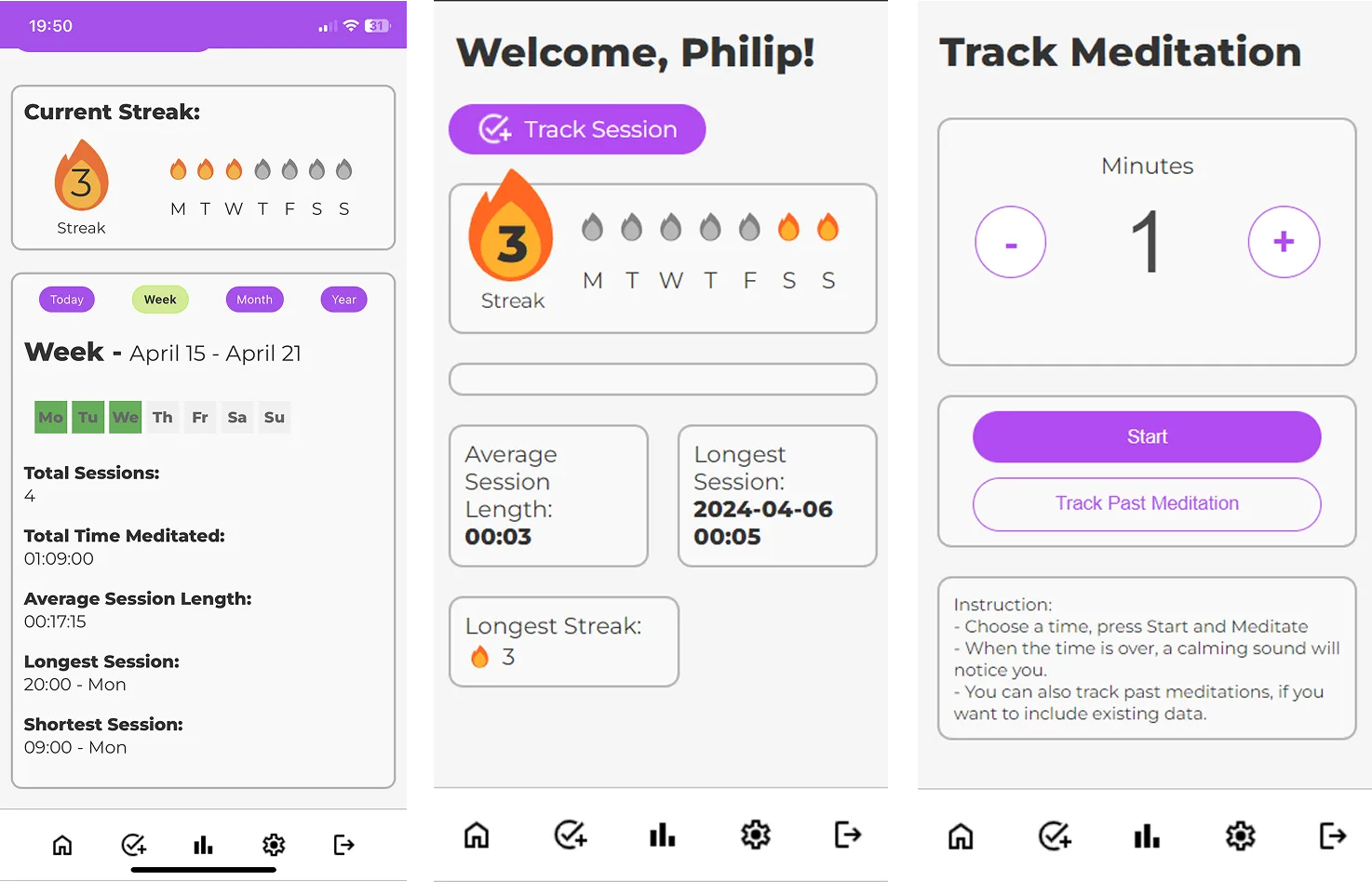
Before HabitHeat became a general habit tracker, I built smaller tools for specific habits. I had some workout tracking ideas, and I built a meditation tracker that was originally just running locally for myself. At first it did not really have a proper name. Later, when I thought about putting it online, I called it Mediterra. After a while I changed the name to Meditery because I liked that better.
The app had a small panda as a logo. It also had a big streak number and a heatmap. Looking at old screenshots now, it honestly looks pretty bad compared to what HabitHeat looks like today. But I like that. It is a cool reminder of how far the product has come. Back then it was rough, but the idea was already there: I wanted to see my meditation habit over time.
One of the first product problems I ran into was the meditation timer.
I wanted Meditery to work like a real meditation app. I wanted to start a timer on my phone, meditate, and then have the app know when I was done. I built it as a PWA and tested it on my Android phone, but then I learned that PWAs do not have the same background behavior and native alarm functionality as real mobile apps. The app could not really behave the way I expected it to behave in the background.
That was frustrating at the time, but it also taught me something important: I was not just trying to build a meditation timer. I was trying to build a better way to see a habit over time.
Mediterra/Meditery were still very far away from HabitHeat, but they helped me understand the direction. I did not want to build a tool for only one specific habit. I wanted something more flexible, a general habit tracker where different kinds of habits could live in one place.
That became HabitHeat v1.
HabitHeat v1 was the first real version
HabitHeat v1 came around 2023 or 2024. It was no longer just a meditation tracker. It was a general habit tracker.
Compared to Meditery, it was a completely new product. It already had heatmaps and a lot of the ideas that still exist in v2 today. In many ways, HabitHeat v1 was already pointing in the right direction. It just was not as clean, polished, or well-structured as I wanted it to be.
The first version still had a different feeling around the brand. The name “HabitHeat” naturally pushed me toward heat, fire, warmth, and orange. At one point the logo was literally an illustrated flame. That made sense at the time. Heatmaps, heat, habits, streaks, fire. It all connected visually.
But over time, I started to feel that this was not really the soul of the product.
HabitHeat v1 was not extremely gamified in the way Meditery could have become, but the whole habit tracker world is full of streaks, badges, points, and motivation mechanics. And I also thought about those things a lot. I liked Duolingo’s streak system. I thought about copying parts of that kind of motivation loop. Streaks are powerful. They work. They can be very motivating.
But they also change the relationship you have with the habit.
When the streak becomes the main thing, losing the streak can feel like losing the habit. I know that feeling from apps like Duolingo. If you have a long streak and then you break it, it can sometimes make you stop completely for a while. I am sure these apps have a lot of data around this, and maybe they solve it with streak freezes and other mechanics. For Duolingo, it probably makes sense. Their product is playful, competitive, and built around that loop.
But for HabitHeat, that started to feel wrong.
I did not want the app to make people feel like the only thing that matters is never missing a day. Real habits are messier than that. Life gets busy. You move. You change jobs. You have stressful months. Some weeks are strong, some weeks are quiet, and sometimes you disappear from a habit for a while before coming back.
That does not mean the habit is dead.
Sometimes coming back is the most important part.
Meditation became the habit that stayed
Meditation is the habit I have tracked the longest in HabitHeat.
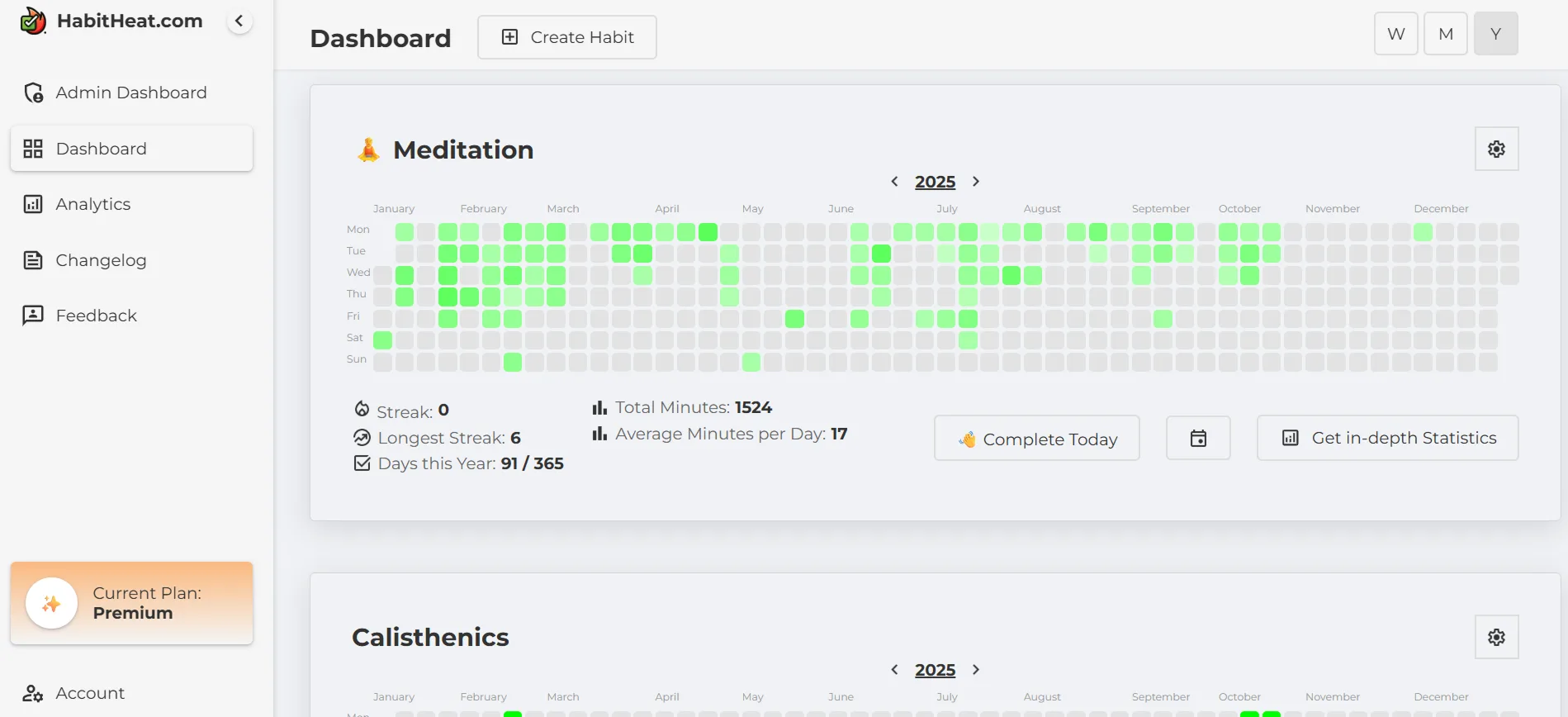
The cleanest part of my meditation history starts on February 24, 2023, and it continues until today. That means I now have more than three years of meditation data, and with 2026 it is already the fourth year this habit appears in my life. I also have older meditation entries in old spreadsheets from 2021, so the full story is probably even longer, but the clean HabitHeat history starts in 2023.
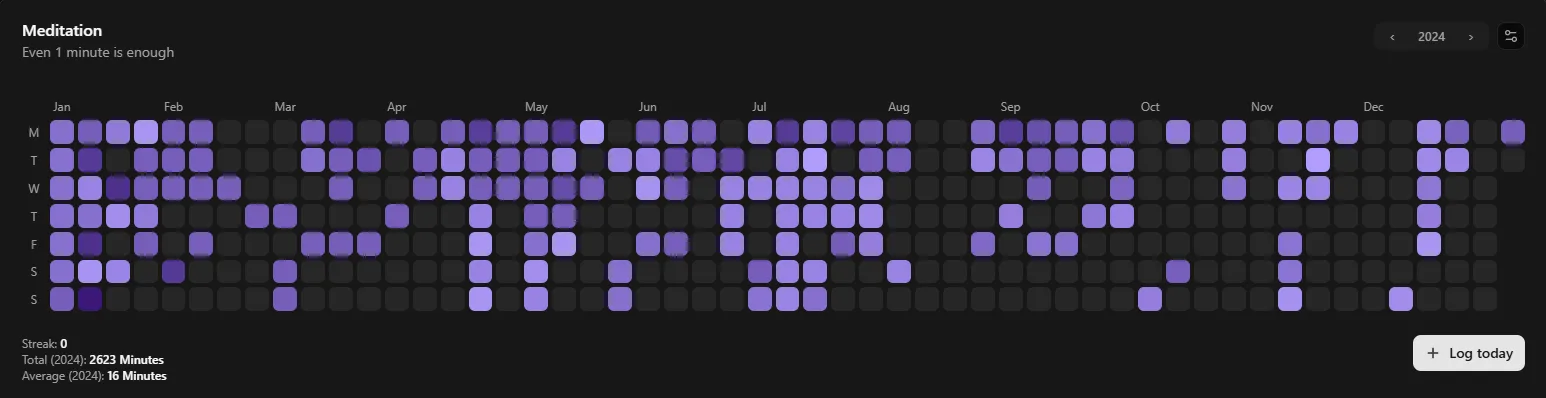
I track meditation as minutes. Not just done or not done. I like seeing the total volume grow over time. That is one of my favorite things in HabitHeat. A single 10-minute meditation can feel small. It can feel like almost nothing. But when you track it over months and years, those minutes become visible.
In 2024, my meditation habit reached 2,623 total minutes. That was my strongest year so far. In 2025, it dropped to 1,524 minutes, because it was a more stressful year with more gaps. But I still came back. And what I find interesting is that the average session length stayed surprisingly stable. In 2024, my average meditation session was 16 minutes. In 2025 and 2026 so far, it has been around 17 minutes.
That kind of insight is exactly why I love HabitHeat.
It is not about pretending every year is perfect. It is about seeing the truth. Some years are stronger. Some years are harder. Some months are full. Some months have gaps. But the habit can still stay alive.
When I look at my meditation heatmap, I do not just see data. I remember phases of my life. I can look at quiet periods and often know why they happened. Maybe I moved. Maybe work was stressful. Maybe there was a job change. Maybe I was just not in a good rhythm. The heatmap becomes connected to memory.
That is the part I never got from a simple checklist.
A checklist is about today.
HabitHeat is about what today becomes when you keep adding days to it.
The history became the point
One funny and slightly annoying part of this whole journey is how often I moved my meditation data.
Some of it started in notebooks. Then some of it was in Google Sheets. Then it moved into Meditery. Then into HabitHeat v1. Then into HabitHeat v2. I tried to keep as much of it as possible, but I am sure some entries are still missing somewhere in old documents or notebooks.
Moving data manually is not fun.
When I moved data from v1 to v2, I even built keyboard support into HabitHeat to make the process easier. I wanted to click a cell, enter a value, press Enter to save, and continue quickly. I added autofocus to the input field and made saving with Enter possible. I also used Tab to move through entries, although not yet in the exact way I would like. At some point I still want proper arrow-key navigation for heatmap cells, because that would make this kind of data entry much smoother.
That sounds like a small detail, but it says a lot about the product. HabitHeat is not only about adding new features. It is also about making the experience of working with habit data feel natural.
And the reason I cared enough to move all that data is simple: I did not want to lose the history.
The history was the point.
That is when HabitHeat started to become more than just a tracker to me. It became a place where I could preserve the habits I kept coming back to.
Why HabitHeat is not streak-first
HabitHeat still has streaks.
I do not hate streaks. I actually think they are useful. They can help you notice consistency, and they can be motivating when they are used in the right way. But I do not want HabitHeat to be a streak-first habit tracker.
For me, the focus should be the data itself. How often did you show up? How much did you do? What changed over time? Which days worked best? Which months were strong? Where did you disappear? Where did you come back?
A streak is only one small part of that picture.
I want HabitHeat to feel more like an honest mirror than a game that pressures you to protect a number. If you have not meditated for a long time, HabitHeat should show that clearly. Not to shame you, but because it is true. If you are trying to stop a bad habit and you have not done it for 10 days, HabitHeat should show that too. That is also progress.
This neutral view is important to me.
A lot of habit apps are built around the idea of performing every day. They try to keep you motivated, push you back in, protect your streak, or make you feel like missing a day is a big failure. I understand why that exists. But I do not think that is what HabitHeat should be.
HabitHeat is more about staying aware.
It gives you a clear picture of what is happening, but it does not need to scream at you. It does not need to make your habits feel more dramatic than they are. Most habits are not dramatic. They are slow, repetitive, and sometimes almost invisible while they are happening.
That is why looking back matters so much. A single entry can feel small in the moment, but over time those entries start to show something bigger: where you were consistent, where you disappeared, and where you came back.
Rebuilding HabitHeat from scratch
Eventually, I rebuilt HabitHeat from scratch.
That became HabitHeat v2. The goal was not to create a completely different product, but to rebuild the foundation properly. v1 was already going in the right direction, but it was not as clean as I wanted it to be. The new version has a better structure, a cleaner interface, better performance, more polish, and a clearer focus on the things that make HabitHeat valuable over time.
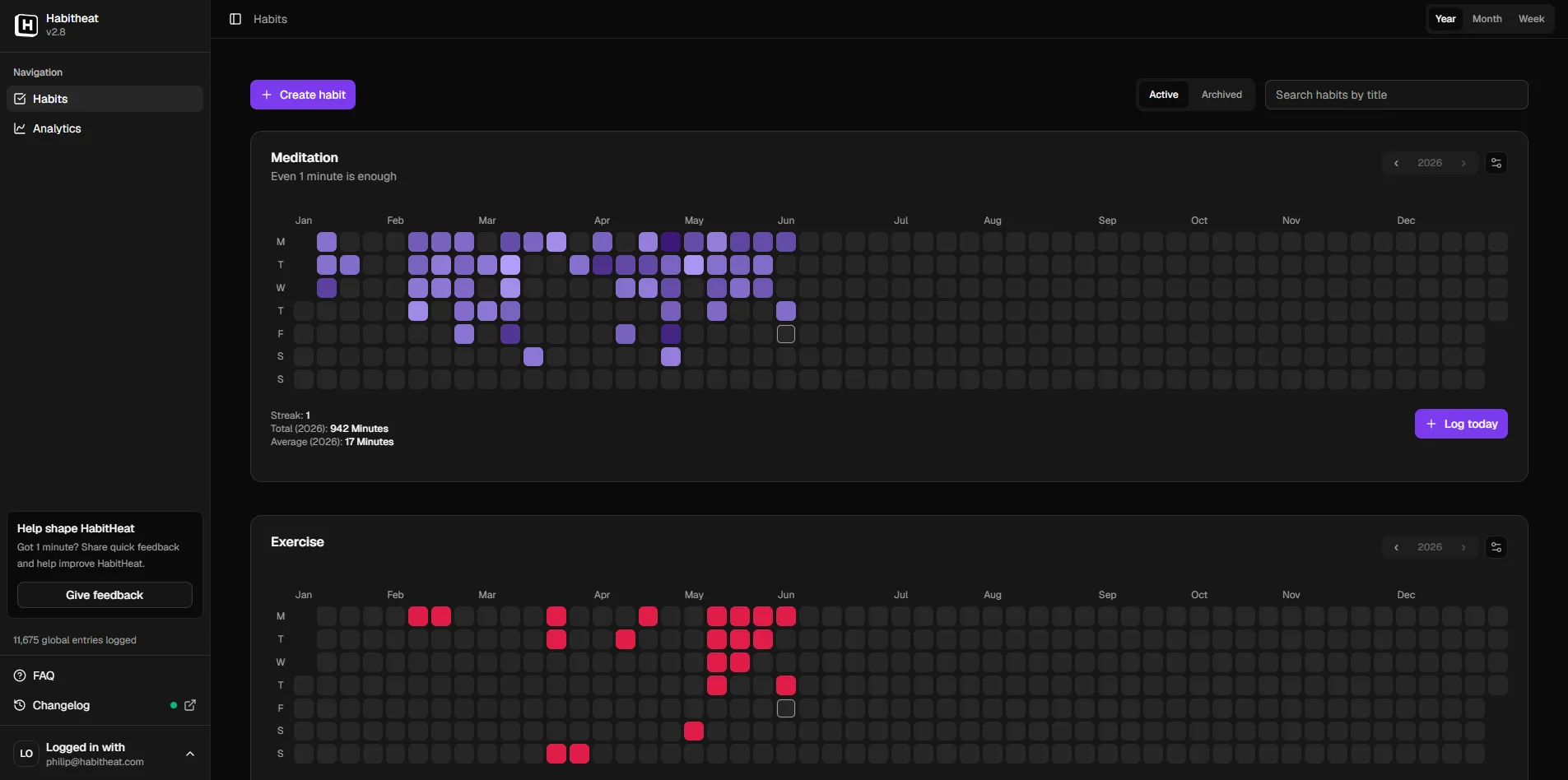
Heatmaps are still at the center. Analytics became more important. Different habit types make the app more flexible, because not every habit is just yes or no. Some habits are numbers, like meditation minutes or pages read. Some are options, like mood. Some are timers. Some might be habits you want to do more often, while others might be habits you want to avoid.
But even with all these features, the core idea is simple:
Small entries become a visual history.
That is the sentence I keep coming back to.
The app becomes more valuable the longer you use it. On day one, it is just a tracker. After a few weeks, it becomes a pattern. After a few months, it becomes a record. After years, it becomes something you can look back on and actually feel.
That feeling is why I keep building HabitHeat.
The brand had to catch up
After rebuilding the product, I started to notice something else: the brand did not fully match the app anymore.
The v2 logo was more calm than the old flame logo. It used heatmap cells and a small bar-chart-like shape. The landing page used orange because orange still felt connected to the “heat” part of HabitHeat. It made sense from the outside. Orange, heat, habit tracker, action, motivation.



But when I looked at the actual web app, it did not feel orange at all.
The app itself felt calmer. More minimal. More focused. It had light and dark mode, clean surfaces, neutral UI, charts, heatmaps, and a slower feeling. The landing page and the app started to feel like two different worlds. The website still had some of that warm, active, SaaS-like energy, while the product was becoming quieter and more reflective.
That made me rethink the design direction.
I do not think HabitHeat needs to be loud. Habits are not loud either.
Most of the time, habits are boring in the best possible way. They are repeated quietly. They do not always feel exciting. You do not always feel like you are changing your life. You sit down, meditate for 10 minutes, enter the number, and move on. One day like that is not impressive.
But years of those days are.
That is what the brand should communicate.
So the new direction is calmer. Less orange. Less fire. Less “motivation app”. More focus on long-term patterns, visual history, and the feeling of looking back. I started moving toward purple as the primary color, because it feels more reflective and calm. I also started testing a simpler logo: a small block with an H inside it. It does not try to explain every feature of the app. It just feels more like an object, a little tool, a small piece of a larger history.
This will probably become its own article, because the redesign is a whole story by itself. But it connects directly to why I built HabitHeat in the first place. The product became clearer, so the brand had to become clearer too.
What I want HabitHeat to become
The longer I work on HabitHeat, the clearer the long-term vision becomes.
I do not want HabitHeat to become a loud productivity app. I do not want it to be full of pressure, notifications, artificial urgency, or features that make you feel bad when you are not performing perfectly. There are already enough apps that try to pull you back in every day.
The vision for HabitHeat is much simpler: I want it to become a personal habit archive.
A place where people can track the habits they care about, as often as they need to, without pressure. A clean experience for seeing what you did, how often you came back, how your habits changed, and what slowly became part of your life. Some people might track every day. Others might only track certain phases. Some habits might stay for years. Others might only matter for a week. I think all of that is fine.
Not every habit needs to become a lifelong identity. But the ones that do stay should have a place to live.
One of the next ideas I am especially excited about is public profiles and habit embeds. Everything would be optional and private by default, of course. But I like the idea that someone could choose to share a habit publicly, embed it somewhere, or put their HabitHeat profile on a personal website, portfolio, Notion page, Obsidian vault, or social media profile.
For example, I could embed my real meditation habit on the HabitHeat homepage and show the actual live data behind the story of this app. Someone else could share a running habit, a study habit, a writing habit, or a programming habit. A creator could say, “I worked out today,” and link to the habit. A developer could show how often they practiced coding. A student could share a study streak with a small group of friends.
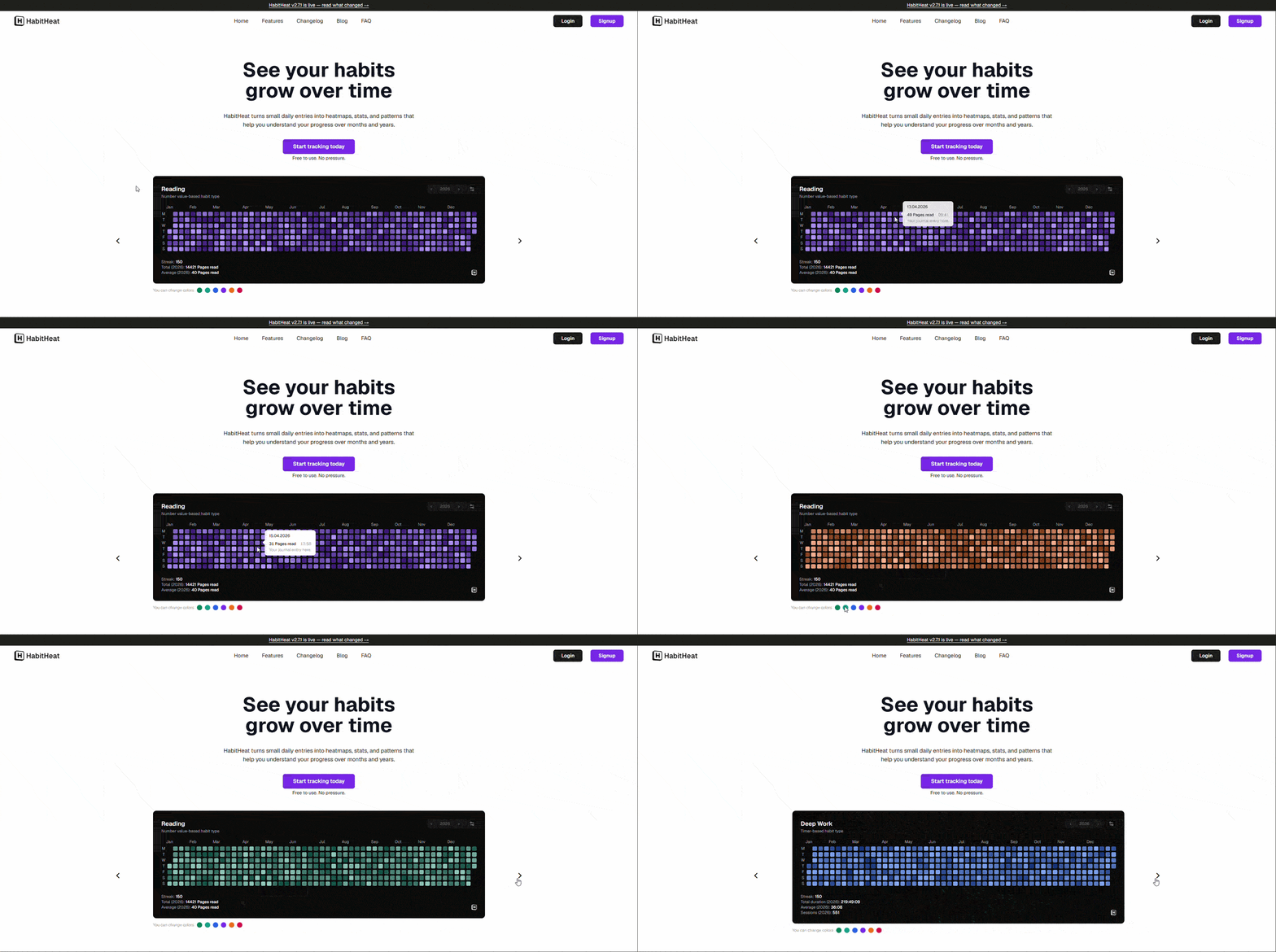
I do not know exactly how far this idea should go yet, but I like the direction. It could become the first step toward something more community-oriented around habits, without turning HabitHeat into a noisy social network.
There are a lot of possible directions here. Public profiles are one. Embeds are another. Partner habits or small group habits could also be interesting, where you share a habit with a partner, a friend, or a small study group and everyone tracks their own progress around the same idea. I have also thought about community habits, where many people contribute to a shared habit, but that is more complicated. I do not want HabitHeat to become something where everything needs to be verified or controlled. The app should still feel honest and lightweight.
So I am not trying to force the community side too early.
The personal archive comes first.
There are also many product features I want to build over time. A proper native mobile app would be a big step, especially for people who want HabitHeat to feel more like a real daily companion on their phone. More detailed analytics are also important to me, but they need to stay understandable. I do not want to overload the product with charts just because I can. The analytics should help you understand your habits, not make the app feel like a business dashboard.
I also want users to be able to export their data. That matters to me because I know exactly how annoying it is to move habit data between systems. I have done it myself too many times. Exporting data is also a trust thing. If people build years of history in HabitHeat, they should know that the data is not locked away forever. Some advanced features like exports or, later, API access could become part of an optional supporter plan, because they can be more resource-intensive. But the core of HabitHeat should stay free.
I can also imagine a future API or webhook system where people can automate habit tracking from other tools. Maybe someone tracks a workout automatically, sends a coding session from their own script, or connects HabitHeat to tools like Make or Zapier. I do not know when that will happen, but the idea fits the larger vision: HabitHeat should be a place where your habit history can come together.
Another idea I really like is a yearly habit recap, almost like a Spotify Wrapped for your habits. How many minutes did you meditate this year? Which habit did you come back to the most? What was your strongest month? Which habit disappeared and came back later? How did this year compare to last year? That kind of feature would fit HabitHeat perfectly, because it is all about looking back and understanding what happened over time.
Monetization is something I think about carefully. I do not want HabitHeat to become a product where the core experience is hidden behind a paywall. My current idea is more like an optional supporter plan, maybe around 5 euros per month, for people who want to support the project and get a few extra features like exports or advanced integrations later. I could also imagine a small sponsor spot if the right company is interested, but I do not want to sell user data, add aggressive monetization, or make the app feel worse for people who use it for free.
The emotional goal is still simple.
I want people to use HabitHeat and feel that it genuinely helps them. I want them to open it every day, or every few days, and feel like it is a calm place to check in with themselves. I want to keep collecting feedback, talking to users, and improving the app until it feels like the best version of this idea. Some users have already sent really helpful feedback, and that always means a lot to me. It makes the product feel alive.
I know I need to keep the vision clear. I do not want to add every idea just because it sounds interesting. But I also want HabitHeat to grow naturally from the way people actually use it.
If I imagine HabitHeat a few years from now, the dream is not just that it has more features.
The dream is that many people have built years of habit history inside it. Quiet records of meditation, reading, workouts, studying, writing, learning, recovery, or whatever else mattered to them. Not perfect histories. Real ones.
That is what I want HabitHeat to become.
A personal archive of the habits people kept coming back to.
What HabitHeat means to me now
HabitHeat is not just a habit tracker to me.
It is the result of years of trying to understand my own behavior. It came from notebooks, spreadsheets, old apps, failed ideas, manual data migrations, meditation sessions, stressful years, quiet months, and the feeling of always coming back to certain habits.
The more I use it, the more I realize that the best part of habit tracking is not the moment you check something off today. That can feel good, but it is not the real reward.
The real reward comes later.
It comes when you open the app after months or years and see what stayed with you. It comes when you see that even with gaps, stress, and imperfect phases, a habit still became part of your life. It comes when you can look at the data and remember the person you were during those weeks and months.
That is the kind of habit tracker I want HabitHeat to be.
I do not want it to feel like a loud productivity app that pushes you to perform perfectly every day, or like a game where the streak becomes more important than the habit itself.
I want it to feel calmer than that. A place where you can track honestly, return after gaps, understand your patterns, and slowly build a visual history of the things you kept coming back to.
That is why I built HabitHeat.
And honestly, I think I am only now starting to fully understand what it is supposed to become.
Thanks for reading,
Philip